
Water Screen Projection Systems: Semi-Circular Water Fan Nozzles, Laser Graphics & Turnkey Multimedia Shows in India
Engineering guide to water screen projection systems for outdoor lakes and musical fountains. Learn semi-circular hydro-shield nozzle physics, projector lumens, laser sync, and pump sizing in India.
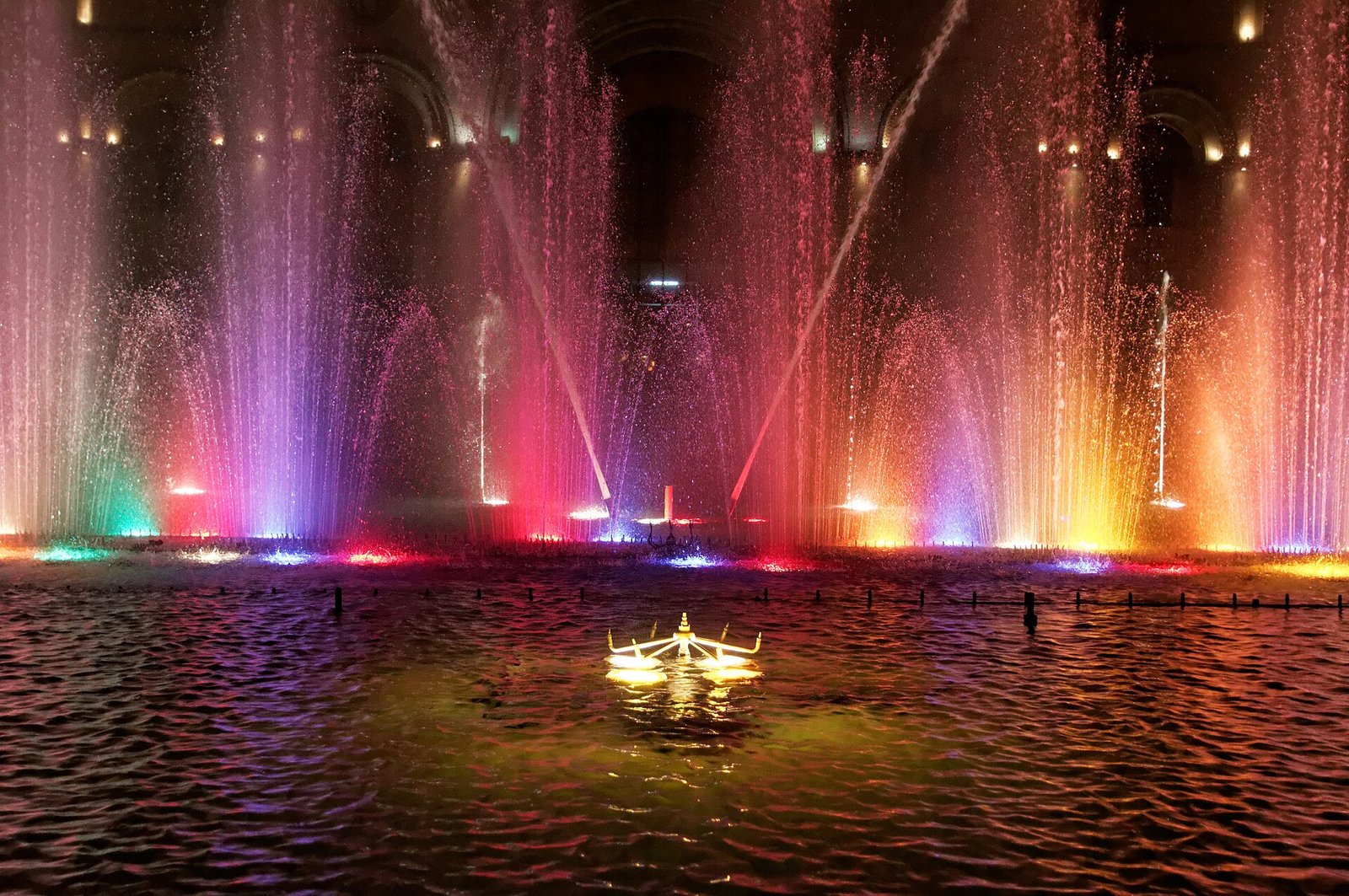
1. Hydraulic Mechanics: Semi-Circular Hydro-Shield Nozzle Engineering (15m to 40m Throws)
The water screen's optical clarity depends entirely on the precision of its hydraulic discharge nozzle. Known in fountain engineering as a 'Hydro-Shield' or water fan nozzle, the unit channels massive water volume into a narrow aperture where two opposed, high-velocity planar streams collide and spread outward across a calibrated 180° semi-circular disc. Fludio hydro-shield nozzles are precision-milled from heavy-gauge marine 316L stainless steel to withstand operating pressures between 3.5 bar and 6.0 bar without blade distortion. The resulting water fan maintains a uniform, continuous film thickness of 2 to 4 millimeters across its entire surface, ensuring no dark voids or gaps interrupt the projected imagery.
2. Optical Physics & Projector / Laser Sizing: Forward Scattering & Lumen Demands
Water screens are optical transmission surfaces that operate on the principle of forward scattering (rear projection). Video projectors and show lasers must always be positioned behind the water screen relative to the audience. Because light passing through micro-atomized water droplets undergoes forward Mie scattering, viewers on the opposite bank perceive an intense, luminous holographic image. Video projectors must deliver high luminous flux to overcome ambient lake light: Fludio specifies minimum 20,000 ANSI lumen laser projectors for 15m screens, and dual-stacked 35,000 to 50,000 lumen projectors for 30m+ municipal screens. For lasers, 10W to 30W high-speed RGB beam scanners produce razor-sharp vector graphics and volumetric aerial beam effects.
3. Submersible Pump Sizing & Intake Strainer Engineering (25 HP to 75 HP)
Generating a stable 25-meter water screen requires immense hydraulic power: typical flow rates range from 180 m³/h to 450 m³/h at high discharge heads (35m to 60m). Fludio pairs its hydro-shield nozzles with continuous-duty IP68 submersible turbine pumps ranging from 25 HP to 75 HP. In natural lakes and reservoirs across Maharashtra, Rajasthan, and Karnataka, suction intakes are vulnerable to floating debris, aquatic vegetation, and silt. Fludio integrates self-cleaning dual-stage 316L intake strainers with internal flow rectifiers, maintaining water intake velocity below 0.5 m/s to protect fish life and prevent nozzle clogging during live shows.
4. Wind Tolerance Mitigation & Variable Frequency Drive (VFD) Automation
Because an atomized water fan has a high surface-area-to-mass ratio, outdoor crosswinds represent the primary operational challenge. Wind speeds exceeding 18 km/h cause the upper crest of the water fan to shred, spilling mist downwind. To preserve audience comfort and equipment safety, Fludio integrates ultrasonic digital anemometers linked directly to the main PLC control panel. When wind gusts exceed predetermined thresholds, the automation system dynamically ramps the ABB/Siemens VFD frequency down from 50 Hz to 42 Hz, proportionally lowering screen height while maintaining water film density, preventing audience overspray without abruptly shutting down the show.
5. Turnkey SMPTE Timecode Integration: Synchronizing Water, Audio, Video & Lights
A captivating multimedia fountain show demands frame-accurate synchronization between dancing water jets, underwater DMX lights, laser beam scanners, video projection, and high-fidelity surround sound. Fludio's central control room architecture utilizes SMPTE LTC timecode to lock all subsystems to a single master clock. The media server streams high-definition video to the projector while simultaneously triggering DMX512 packets to moving nozzles and underwater LED spotlights at 44 refresh cycles per second, ensuring that water choreography and visual projections hit every musical crescendo in exact millisecond lockstep.
Water Screen Projection System Engineering Specifications
| Screen Category | Water Fan Dimensions | Flow Rate & Head Pressure | Pump Power (HP) | Recommended Projector Lumens | Target Application |
|---|---|---|---|---|---|
| Compact Resort Screen | 15m Wide x 8m High | 180 m³/h @ 35m Head | 25 HP Submersible | 16,000 - 20,000 ANSI Lumens | Luxury Hotel Pools & Private Lagoons |
| Standard Commercial Screen | 25m Wide x 12m High | 280 m³/h @ 45m Head | 40-50 HP Submersible | 25,000 - 35,000 ANSI Lumens | Destination Resorts & Waterfront Plazas |
| Large Municipal Screen | 35m Wide x 18m High | 420 m³/h @ 55m Head | 60-75 HP Submersible | 40,000 - 60,000 ANSI Lumens (Stacked) | Smart City Lakes, Dams & Theme Parks |
| Mega Waterfront Screen | 45m Wide x 22m High | 550 m³/h @ 65m Head | Dual 50 HP Tandem Pumps | 60,000+ ANSI Lumens + 30W Lasers | Iconic Landmark Tourism Attractions |
Technical FAQs
Can water screen projection be installed in an existing natural lake?
Yes. Fludio specializes in floating water screen skids constructed from UV-stabilized rotomolded HDPE pontoons with 316L stainless steel framework. The floating platform anchors into the lake bed, rising and falling with natural seasonal water level fluctuations without requiring any permanent civil concrete work in the water body.
What happens if someone projects from the front instead of the rear?
Front projection onto a water screen causes severe image washout and low contrast because water droplets transmit light forward rather than reflecting it backward. Rear projection (projector behind the water screen aimed toward the audience) is mandatory for vibrant, holographic-quality visibility.
How far back must the video projector be positioned from the water screen?
Projector throw distance depends on lens focal length (throw ratio). With standard short-throw lenses (e.g., 0.8:1 to 1.2:1), a 25m wide water screen requires a projector throw distance of approximately 20 to 30 meters from the rear.
Can water screen projection systems show normal movies and animated graphics?
Yes. The water screen displays any high-definition video feed, animated 3D graphics, corporate presentations, and synchronized laser beam shows. High-contrast content with dark backgrounds yields the most dramatic holographic 3D illusion.
What is the typical lifespan of Fludio's hydro-shield water screen nozzle?
Manufactured from solid marine-grade 316L stainless steel with CNC-profiled discharge lips, Fludio hydro-shield nozzles operate continuously for 15+ years in fresh or treated water with zero corrosion or nozzle deformation.
Have a Fountain Project Requiring Expert Engineering?
Consult with Fludio's hydraulic engineers for complete DMX 512 choreography, pump sizing, and certified 304L stainless steel hardware.
Consult Our Engineering Team